SAI Regenerating Together Programme: Continous Improvement for Scalable Impact
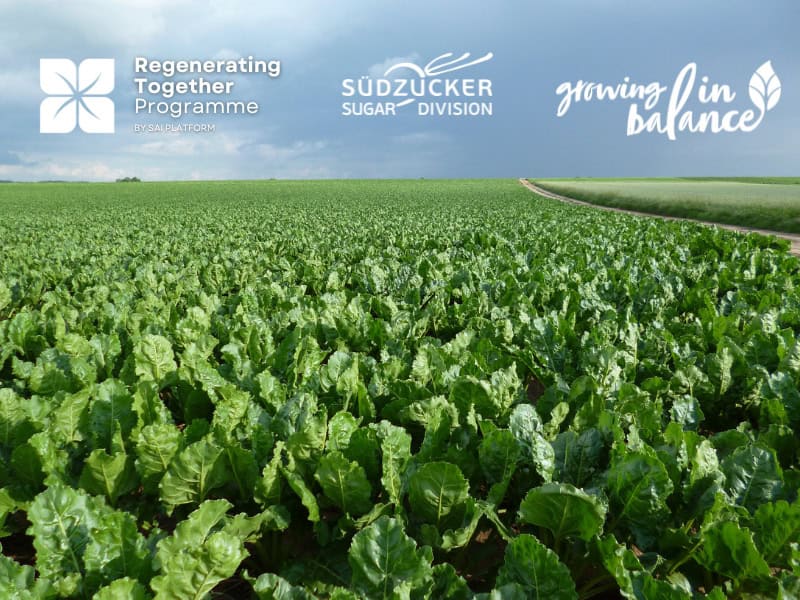
With the Regenerating Together Programme, SAI Platform has launched an initiative that goes far beyond a traditional sustainability programme. More than 40 companies have formally subscribed to the declaration of intent and many more are already involved across the initiative, including suppliers, brand manufacturers and organisations across the entire value chain. With a shared framework, the programme offers a response to an important challenge facing the sector: the lack of a shared understanding of regenerative agriculture.
To this day, there are many definitions, interpretations and approaches to regenerative agriculture. Every stakeholder associates something different with the term. The core problem lies not only in the diversity of definitions, but also in the fact that the industry has long failed to speak a common language. Without uniform standards, data cannot be compared, progress is difficult to measure, and successful approaches remain localised, are not transferable and are therefore difficult to scale up. Added to this is the significant effort required to validate individual measures.
Yet much has already been achieved in the field of regenerative agriculture: Companies, farmers, supply chain partners and industry organisations have developed various approaches, implemented pilot projects and gathered valuable insights in recent years. So there is certainly no shortage of knowledge, experience and effective approaches. What has been missing, however, is a common framework that links all these activities and makes them comparable.
Industry Standard Enables Scaling
This is precisely where the SAI Regenerating Together Programme comes in. For the first time, key industry players have come together – including growers, raw material suppliers, brand manufacturers, food companies, and environmental organisations (such as Earthworm) acting as intermediaries. Together, they have laid a foundation: a shared understanding of regenerative agriculture.
This foundation enables a common language and forms the basis for a structured system: a clearly defined framework for implementing regenerative measures, a consistent methodology for assessing impact, and an auditable benchmark for regenerative claims. As a result, initiatives become comparable for the first time, progress can be measured consistently, and positive effects can be scaled across global value chains.
Building on an Established Foundation
For Südzucker, the SAI Regenerating Together Programme is not a new beginning but rather a next step. We have long followed a structured four-step approach of analysing, setting goals, taking action and measuring progress to drive continuous improvement in beet cultivation. The programme builds on this established foundation by providing a harmonized industry framework that enables results to be compared, verified and scaled beyond individual initiatives.
In practice, this creates greater clarity and guidance for all stakeholders. It establishes a common understanding of what ‘regenerative sourcing’ means, how progress should be measured, and how outcomes can be verified and reported.
What were once numerous individual and often disconnected initiatives can now be integrated into a coordinated system that creates transparency, strengthens trust and enables large-scale implementation.
Here you can find out more about Südzucker’s initiative “The Connected Collective” and get to know Südzucker’s understanding and approach to more regenerative agricultural practices.
Trust and Clarity
For raw material suppliers, this means, above all, greater structure and better alignment with their customers’ requirements. Progress can be clearly communicated, pilot projects scaled up more easily, and trust among buyers grows. At the same time, economic opportunities open up, for example through preferential partnerships or potential price premiums. Another key benefit is the reduction of greenwashing risks, as claims are based on a verifiable and standardised foundation.
The added value is also considerable for brand manufacturers. In an environment where sustainability claims are increasingly being scrutinised, credibility becomes a decisive factor. Standardised measurement methods and verifiability enable robust claims and create transparency. This strengthens the trust of consumers and stakeholders.
Risk Mitigation for Farmers
For farmers, the programme brings greater clarity and a targeted reduction in risks. The programme aims to mitigate the risks associated with the transition to regenerative practices, as regenerative measures can lead to lower yields and uncertain outcomes in the short term which is a risk that hardly any farmer can bear alone. A successful transition to regenerative agriculture therefore requires a mix of safeguards: pilot programmes, trial plots and agronomic advice enable a gradual introduction, whilst premiums, financial incentives, off-take guarantees and co-investments reduce economic risks. As regenerative agriculture is highly site-specific and knowledge-intensive, supplementary training, advisory services, farmer-to-farmer learning networks, as well as digital tools and structured data collection are crucial. Support with reporting and verification, along with common standards, creates additional transparency and comparability.
In this way, measures are no longer implemented ‘at a guess’, but are specifically selected and evaluated on the basis of concrete results. Progress is made visible, and developments can be tracked over time. This not only increases planning certainty but also strengthens trust and the willingness to invest in new practices. It also highlights which approaches are both ecologically and economically viable. At the same time, collaboration along the value chain is facilitated. This is a key prerequisite for the widespread implementation of regenerative practices.
And Beyond – it Matters for all of Us
The programme’s impact extends beyond individual stakeholders. When results are measurable and based on a shared logic, they become scalable. Improvements in soil quality, biodiversity or the water cycle can not only be demonstrated but also systematically expanded. This leads to more resilient agricultural systems in the long term and ecological effects with a broader impact. The Regenerating Together Programme thus marks a turning point as it offers a common language. Only when all stakeholders share the same understanding of ‘regenerative’ results will become comparable, statements reliable and progress scalable. And this is where the real transformation lies: many individual initiatives come together to form a shared, effective process of change.
Discover fresh perspectives from the food industry through customer stories, expert insights, and the latest developments across the value chain.