Südzucker Polska Pioneers Verified Zero-CO₂ Sugar
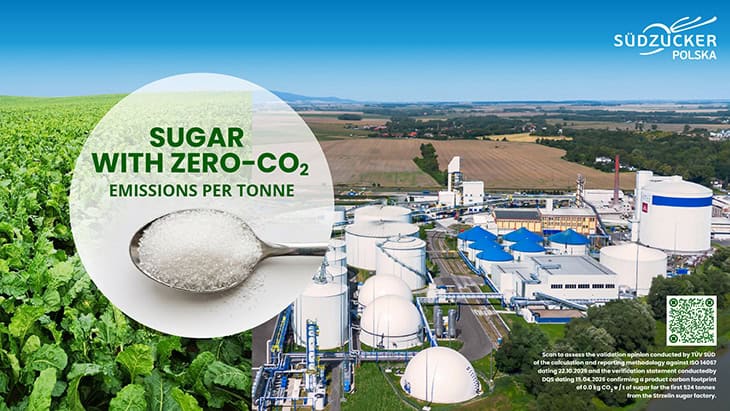
The Südzucker Polska S.A. Strzelin sugar factory, part of Südzucker Sugar Division, has taken a pioneering step by producing European beet sugar with zero CO2 emissions per tonne*. This is the result of a long-term commitment to the energy transition and production decarbonization, consistently implemented in line with circular economy principles.
*Product carbon footprint = 0.0 kg CO₂e/t according to the verification statement from DQS dated April 20, 2026 (CF-VS-260415-1-DQS) and the methodology to calculate and report the partial carbon footprint of beetsugar, validated against DIN EN ISO 14067:2019 by TÜV SÜD as of October 22, 2025 (Validation Opinion VO-4213754), both available at suedzucker.com.
A carbon footprint assessment was conducted for the 524 tonnes of local sugar produced during the 2025/2026 sugar campaign – encompassing everything from beet cultivation to the bulk packaging of the final product as it leaves the factory gate. The result, for a specific, physically produced batch stored in the warehouse, was verified by the independent certification body DQS Polska (a member of the DQS Group) in accordance with ISO 14067.
Strzelin’s energy transformation laid the groundwork for the project
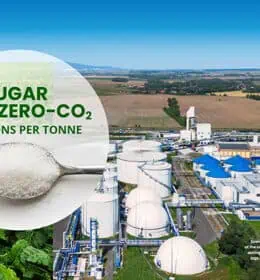
One key component in the process was the expansion of the sugar factory’s biogas plant, which was opened in September 2025. Today, this upgraded infrastructure has a total capacity of 50 MW and is capable of producing over 9,000 m³ of biogas per hour – enough to fuel the plant for throughout the entire sugar campaign. The electricity and heat are generated through anaerobic methane fermentation, using plant by-products (including beet pulp) from sugar production. This enables the facility to create its own zero-emission energy for use in the production process.
“It is precisely this infrastructure that has enabled us to fully close the circular loop in Strzelin. Beet pulp becomes a source of energy, and digestate is returned to the fields as organic fertilizer,” emphasizes Dr Maciej Dobrowolski, Director of Technology and Engineering at Südzucker Polska S.A.
Key decarbonization levers
The elimination of emissions was achieved by:
- Replacing natural gas with biogas in the production process,
- Using renewable diesel fuel for beet transport
- Reducing emissions in beet cultivation through the use of digestate, a co-product from the biogas plant, as an organic fertilizer
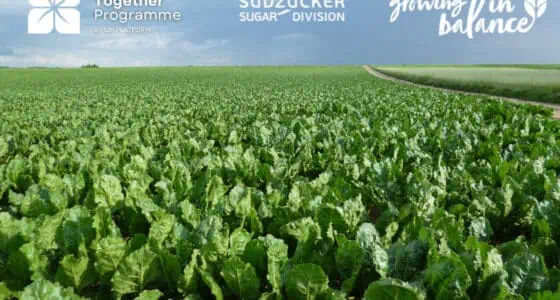
- Removing carbon by implementing regenerative agriculture practices. These focus on diversified crop rotation and residue management, enhancing soil health and enabling carbon to be stored in the soil
The combination of these actions enabled significant emission reductions at every stage, paving the way for this pioneering sugar with zero CO₂ emissions per tonne.
Circularity from the field to the finished product
What makes the project so unique is the end-to-end control and monitoring of the production process for these specific 524 tonnes of sugar. A comprehensive carbon footprint assessment was conducted using a “cradle-to-factory-gate” approach, covering all the key stages: sugar beet cultivation, raw material transport, the production process at the sugar factory, and product packaging.
“Our goal was to create sugar with a product carbon footprint of zero CO2/t, based on reliable data and a validated methodology. We monitored the entire process – from beet sowing to the final product,” underlines Mariusz Pawełek, CEO of Südzucker Polska.
Tangible value for food and beverage producers
This creates an exciting opportunity for food and beverage manufacturers using sugar as an ingredient, who can now reduce emissions across their entire value chain. This is especially relevant for their Scope 3 emissions, which include upstream supplier footprints.
“We have noticed increasing customer demand for sustainable solutions, and our customers need credible environmental data. With this product, they can realistically reduce the carbon footprint of their products while sharpening their competitive edge. All the emissions data for our sugar has been verified by an accredited certification body and is therefore a robust source of information for customers when communicating their products’ reduced CO₂ emissions,” emphasizes Artur Wołowicz, Industrial Sales Director at Südzucker Polska S.A.
The project undertaken in Strzelin is part of the Südzucker Group’s decarbonization strategy, which aims to achieve a 50.4% reduction in Scope 1 and 2 emissions by 2030, and 30,0% reduction in scope 3 by 2030. Today, the Strzelin sugar factory represents one of the most advanced and large-scale examples of a practical energy transformation in the European food industry.