Why Glucose Syrup Plays an Important Role in Industrial Baking
Industrial bakeries are under constant pressure to optimize their recipes. In addition to sweetness, technological properties such as texture, moisture retention, and shelf life, as well as consumer perception, play a decisive role in the selection of sugar types.
Glucose syrup is therefore an important component of industrial baked goods. It serves not only as a sweetener but is also a functional ingredient that influences the texture, appearance, and freshness of baked goods. But how does it differ from white sugar, and what makes glucose an ideal ingredient for baking applications?
Why is Glucose Syrup Used in Industrial Baking?
Used in industrial baking, Glucose syrup helps to keep baked products soft, moist and fresh for longer. They remain appealing and tasty for several days when made with glucose syrup. It also improves the colour and texture of baked goods. Therefore, when selecting ingredients, bakers consider functional aspects when choosing a sweetener such as:
How does Glucose Syrup Differ from Sucrose?
Glucose syrup is a thick, clear, sweet substance made from wheat starch*, whereas sugar comes from sugarcane or sugar beets. The two sweeteners also differ in terms of sweetness: glucose syrup is only 60–70% as sweet as sugar. As a liquid ingredient, glucose syrup mixes well with other ingredients. Additional distinctions include the hygroscopic properties of glucose and the browning reaction.
* We produce our glucose syrup from wheat starch. Depending on the supplier, glucose syrup on the market can also be sourced from corn or potato starch.
Hygroscopic Properties of Glucose
Glucose is hygroscopic – it attracts and binds water. Compared to sucrose, glucose keeps baked goods fresh for longer as it binds moisture. This means baked goods remain soft and elastic for longer. This is particularly crucial for consumer acceptance in products such as sandwich bread or brioche. It reduces drying out and extends shelf life – a decisive advantage for industrial manufacturers.
Glucose and the Browning of Baked Goods
The Maillard reaction, which is responsible for the golden-brown crust and complex flavour compounds, is intensified by glucose. As glucose is a reducing sugar, it reacts more quickly with amino acids in the Maillard reaction than sucrose. This ensures faster and more even browning of baked goods made with glucose syrup.
| Sucrose | Glucose | |
|---|---|---|
| Chemical structure | Disaccharide composed of glucose + fructose | Monosaccharide consisting of a single sugar molecule |
| Sweetness | 100% (reference) | 60–70% |
| Physical form | Crystalline | Mostly liquid (glucose syrup) |
| Moisture retention | Low | High, binds moisture |
| Browning | Browning starts slowly, localised browning | Browns earlier and more evenly |
| Source | Sugarcane, sugar beet | Wheat* |
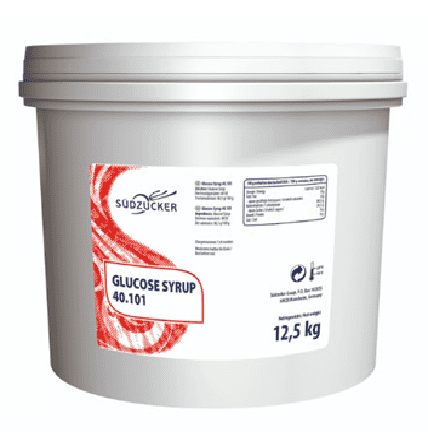
Südzucker Glucose Syrup 40.101 is an aqueous solution of saccharides obtained by hydrolysis, with a dry matter content of 80.5%.
Südzucker offers a comprehensive portfolio of glucose syrups covering different DE ranges and functional properties. Contact us for detailed specifications and application support.
Declaring Glucose: Challenges in the ‘Clean Label’ and Sugar Reduction Era
Glucose is under scrutiny in an era of ‘clean label’ and sugar reduction. Manufacturers should therefore communicate transparently why they use it, emphasising not just its sweetening properties, but also its role as a functional ingredient that contributes to quality and freshness.
Glucose is more than just sugar. It significantly influences the texture, appearance, and flavour of baked goods. It remains indispensable for industrial applications, even as labelling requirements become more stringent.